Product Overview

A quick look at the GLYNT.AI solution

Audit-Ready Sustainability Data

Prepared for ISSA 5000 and other audit standards

Sustainability Data Layer

Works with the software and AI you already use

Approval Workflows for Sustainability Data

Four-Eyes review for audit compliance

Finance-Grade Sustainability Data

The same rigor as financial data

Integrate with Financial Data

Reconcile against your financial ledger

AI-Ready Sustainability Data

See what’s missing or flagged before deadlines

Powered by Green AI

Built for low energy use and emissions

Best Practices for Sustainability Data Management

Manage data instead of wrangling it

Enterprise Security

Privacy, security, and controls

Sustainability Data Accuracy

We test your data so you don’t have to

Comprehensive File Capture

Extract data from scans, portals, and messy formats

Customized Reporting

See what’s missing or flagged before deadlines

Audits & Assurance

Traceable data, approval workflows with SOC compliance

Business Value Add

Customize output files for CSRD, IFSR, CBAM, UKSRS

Energy Data Management

Granular data for transparency and cost reductions

Waste Data Management

Pull files from everywhere, send data to anywhere

Scope 3 & PCFs

Stop chasing suppliers, move to finance-grade quality

Blog

What’s new with GLYNT

Customer Stories

Industry applications for GLYNT solutions

Guides

GLYNT’s expertise and thought leadership
WHY IT MATTERS

Find cost savings, reduce risk, and unlock supplier innovation with sustainability data

Detailed data on energy, water, and waste from GLYNT.AI reveals new ways to save on costs and spur innovative supplier collaboration.

Resource Efficiency

Find resource waste and high-cost contracts.

Meet Customer Requirements

Meet rising customer demand for full, audited reporting.

Risk Avoidance

Find your hotspots and fix them.

Innovation

Collaborate with suppliers using shared, data-driven insights.

Better Data

Start from where you are

Migrate from high-level LCA, surveys, and spend data to actionable, detailed supplier sustainability data.

BEFORE

LCA and spend data rely on high-level averages, with no path to improvement.

MIGRATE

Each year, GLYNT.AI uses invoices, POs, and more to break out detailed data for additional key suppliers.

AFTER

Supplier data gets better every year, expanding your scope for action.

One System

One system covers Scope 3 and supply chain emissions

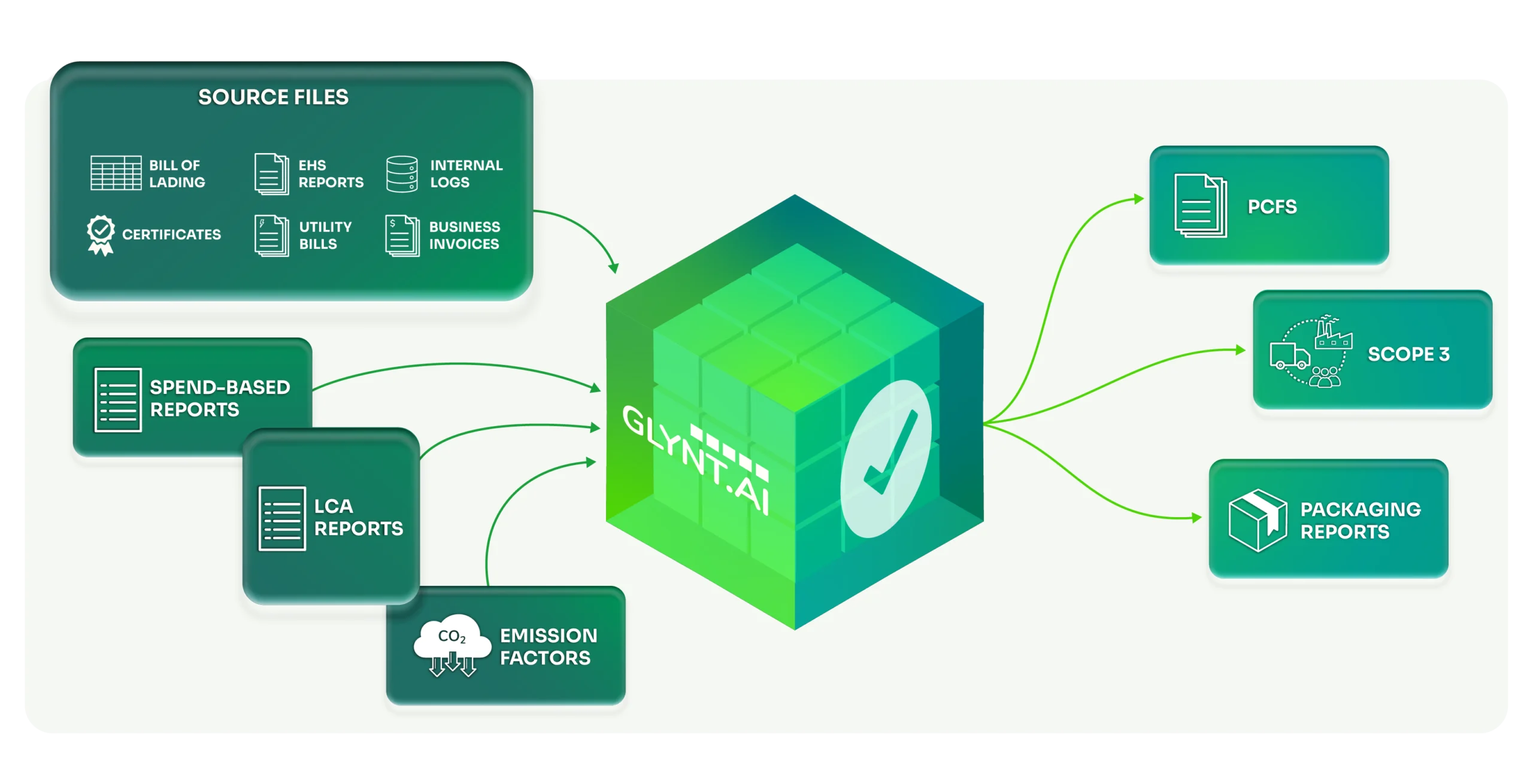
GLYNT.AI extends its unified sustainability data system to Scope 3 and supply chain emissions, using the data you already have.
HOW IT WORKS

Move to more primary data from your supply chain

Meet expanding regulatory requirements with actual supply chain data from GLYNT.AI.

Automate the Files You Have

Get primary activity data from invoices, POs, and other business records.

Bring in the Emissions Factors

Match emissions factors to supplier products.

Integrate with Your Business Data

Provide context and structure with ledgers, codes, and more.

PCF

Prepare product carbon footprint reports from unified data

Get customized PCF reports from a single source of truth. Avoid confusion and errors caused by duplicate, siloed calculations.
One Sustainability Data Set Built once, audited once, ready for customized reporting.
Add Product Data Integrate detail on what you sold, and where it was made.
Customize Your PCF Meet industry standards with tailored calculations and reports.
RELATED QUESTIONS

Frequently asked

Use these questions and answers to learn more about how GLYNT.AI prepares Scope 3, supply chain, and PCF data.
What's the difference between a company-wide carbon footprint and a product carbon footprint?
A company-wide footprint totals Scope 1, 2, and 3 emissions across the whole business. A product carbon footprint (PCF) allocates a share of that combined total to a single unit of a single product. GLYNT.AI calculates the company-wide, activity-based number from primary invoice data and emissions factors, then uses your own sales and production data to divide it down to the product level for PCF reporting.

Why not just report the numbers our suppliers give us?
A supplier’s self-reported number is secondary data you can’t independently verify — and most suppliers don’t have the rigor in place to produce audited data. That leaves you in a bind: regulations and industry standards increasingly demand audited or verified Scope 3 and PCF reporting, but supplier-provided data remains weak. GLYNT.AI’s migration plan puts you in control of that data quality, rather than waiting on your suppliers to get there first.

Do we need to replace the LCA software we use for product carbon footprint reporting?
No. LCA software is a fine starting point — it produces product carbon footprints using industry-average data, plus basic details about your products and company. From there, identify your emissions hotspots and key vendors, and replace their averages with detailed, primary data first. Add another supplier group each year, and let LCA software continue to estimate the long tail.

Can we share data directly with our customers?
Yes. In the automotive industry, GLYNT.AI already helps suppliers report PCF data into Catena-X, the industry’s shared data exchange network. And across numerous industries, PCF reporting is already required in some cases, and expanding to more within a year or two. GLYNT.AI provides the single source of truth on sustainability data, expanded to fit your business and reporting needs — so you’re ready to share corporate and PCF data.

Do we need to replace our carbon accounting software?
No. GLYNT.AI is the data layer underneath it. GLYNT.AI delivers the accurate, audit-ready data those platforms need, and provides you with additional customized reports for PCF and other data sharing.

Prepare supplier data for corporate reporting and PCFs