Product Overview

A quick look at the GLYNT.AI solution

Audit-Ready Sustainability Data

Prepared for ISSA 5000 and other audit standards

Sustainability Data Layer

Works with the software and AI you already use

Approval Workflows for Sustainability Data

Four-Eyes review for audit compliance

Finance-Grade Sustainability Data

The same rigor as financial data

Integrate with Financial Data

Reconcile against your financial ledger

AI-Ready Sustainability Data

See what’s missing or flagged before deadlines

Powered by Green AI

Built for low energy use and emissions

Best Practices for Sustainability Data Management

Manage data instead of wrangling it

Enterprise Security

Privacy, security, and controls

Sustainability Data Accuracy

We test your data so you don’t have to

Comprehensive File Capture

Extract data from scans, portals, and messy formats

Customized Reporting

See what’s missing or flagged before deadlines

Audits & Assurance

Traceable data, approval workflows with SOC compliance

Business Value Add

Customize output files for CSRD, IFSR, CBAM, UKSRS

Energy Data Management

Granular data for transparency and cost reductions

Waste Data Management

Pull files from everywhere, send data to anywhere

Scope 3 & PCFs

Stop chasing suppliers, move to finance-grade quality

Blog

What’s new with GLYNT

Customer Stories

Industry applications for GLYNT solutions

Guides

GLYNT’s expertise and thought leadership
WHY IT MATTERS

Hidden fees, expanding regulations, steep penalties

Waste data is more valuable than ever before for reporting, compliance and efficient business operations.

Corporate reporting

Expanding Scope 3 reporting & audit requirements include Category 5, waste data.

Safety regulations

Reporting on the tracking and handling of e-waste, infectious waste and more is required.

Packaging regulations

One data set, ready for global reporting.

Expense management

Waste disposal costs are rapidly rising, far outstripping inflation in many places.

PACKAGING

Product packaging reporting and reduction regulations are expanding worldwide

GLYNT.AI’s sustainability data system manages this complexity across your global supply chain, where waste disposal practices and reporting requirements vary by locale.

Producers* must file different reports in each locale and reduce waste across their entire global packaging supply chain

*The producer is the entity that introduces packaging into the local market.

Comply by locale

GLYNT.AI’s customized data and reporting meets requirements by locale.

Avoid steep fines

Be ready for any question with GLYNT.AI’s accurate data and audit-ready reports.

Rely on a single source of truth

Get finance-grade waste data from one unified, compliant system.

WHY IT’S HARD

Waste data comes from everywhere, in every format

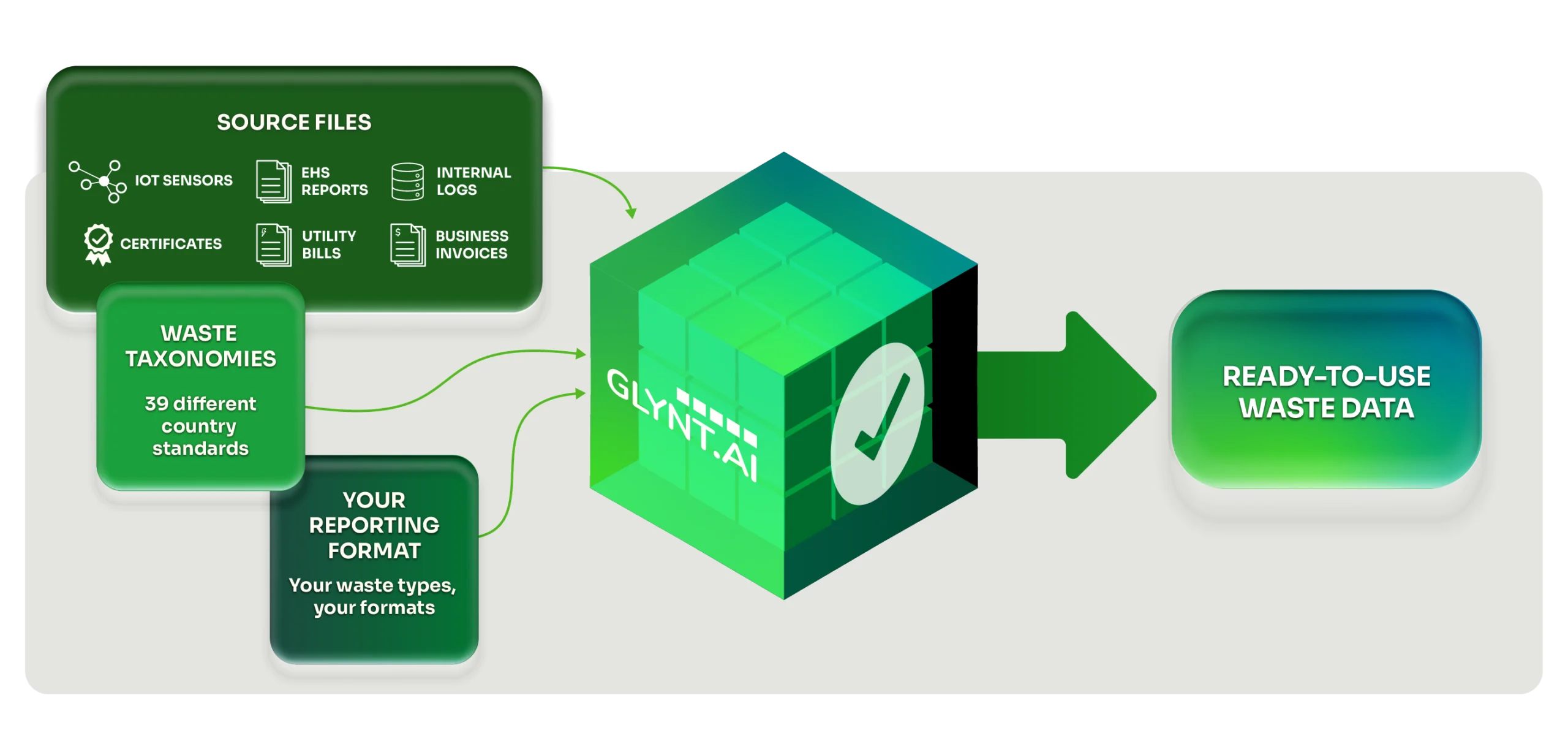
Waste data arrives from a wide range of sources: internal systems, EHS platforms, utility bills, business invoices, landlords and more. And every file has to be mapped to the right waste taxonomy for its locale.
HOW IT WORKS

One system standardizes waste data from every hauler and format

GLYNT.AI turns messy, inconsistent files from every local hauler — in any format — into unified, structured waste data you can use.

CapabilityHow GLYNT.AI handles it
Capture every file GLYNT.AI handles the varied file types and formats
Extract the data Waste abbreviations and acronyms are no problem
Include diversions GLYNT.AI tracks what happens to your waste
Map the data Map each waste stream to all the waste taxonomies
Volume in, weight out Volumes of waste are automatically transformed into weight
Your waste types Add your waste types to GLYNT.AI for customized reporting
Ready for your systems Tailor output files for streamlined data flows
GLOBAL COVERAGE

One system that captures waste detail in every locale

GLYNT.AI translates local waste terminology and taxonomies into one consistent standard, worldwide.

Multi-lingual
support

GLYNT.AI handles non-English languages and non-Latin characters sets, too.

Varied file types & formats

Comprehensive file capture and processing in a single system.

Add in local waste classifications

Map every locale to your unified system, ready for global reporting.

RELATED QUESTIONS

Frequently asked

Learn how GLYNT.AI standardizes and reports your waste data.
Why is waste data so much harder to standardize than energy or water data?
Raw input files for waste data come from many systems: IOT sensors, utility bills, hauler invoices, EHS systems, internal logs and more. And there is no standard format. Plus a waste shorthand is often used — like CY, G, and Gal. GLYNT.AI is a purpose-built system that “speaks waste.”

How do you handle hazardous waste specifically?
Each waste type is tracked separately, including hazardous waste, infectious waste, e-waste and more, enabling full regulatory and safety compliance. GLYNT.AI maps each waste type and details to the correct codes, disposal routes and certificates of destruction.

Our hauler bills by volume, but we report by weight. How does that work?
Transformations from volume to weight are built into the GLYNT.AI system. We track weight and volume so you can monitor hauler conversion factors for accurate billing.

If we switch waste haulers, does our reporting stay consistent?
Yes. GLYNT.AI ‘s change management system automatically detects new vendors and we have a standard approval flow so that your reporting is always accurate and verified.

Can GLYNT.AI process waste invoices that aren't in English?
Yes. Non-English languages and non-Latin character sets are handled in the GLYNT.AI system. For example, one GLYNT customer has waste files in 14 languages on four continents.

How does GLYNT.AI handle waste summary bills?
GLYNT.AI unpacks summary bills and long tables into detail of waste type pickups by service address, providing a consistent aggregated record of the weight of waste by type during the reporting period.

Does GLYNT.AI handle waste codes and reports from outside the US?
Yes. GLYNT.AI is familiar with the waste taxonomies — there are 39 ! — used around the world. The waste codes are extracted from the raw input files or are added to your waste data as needed.

Can we use GLYNT.AI’s waste data services to increase our Primary Data Share?
Yes. Primary Data Share is the percent of your reported data that comes from actual data (e.g. is not estimated). GLYNT.AI processes all of your messy waste files so that you get actual data. This transforms waste from a reporting category that is often estimated to one that has actual data.

Why is it important to report waste by waste type and weight every month?
This level of reporting detail shows stakeholders that you know your waste streams, and you have the data system in place to actively manage waste costs, including avoidance of landfills.

Turn your messy waste files into waste data you can use