
GLOSSARY
Audit-Ready Sustainability Data Requires a System, Not Just a Few Checks on Numbers
GLYNT.AI’s audit-ready data goes beyond simple accuracy tests. It is a complete, verifiable system that enforces boundaries, completeness and reliability.
HOW IT WORKS
The GLYNT.AI system is built on people, process and technology
GLYNT.AI uses the same three elements of financial data preparation that are proven to reduce errors and increase data quality.
People
The sustainability team brings expertise and context to management of the data flows.
AUDIT-READY SYSTEM
5 components auditors check in a sustainability data system
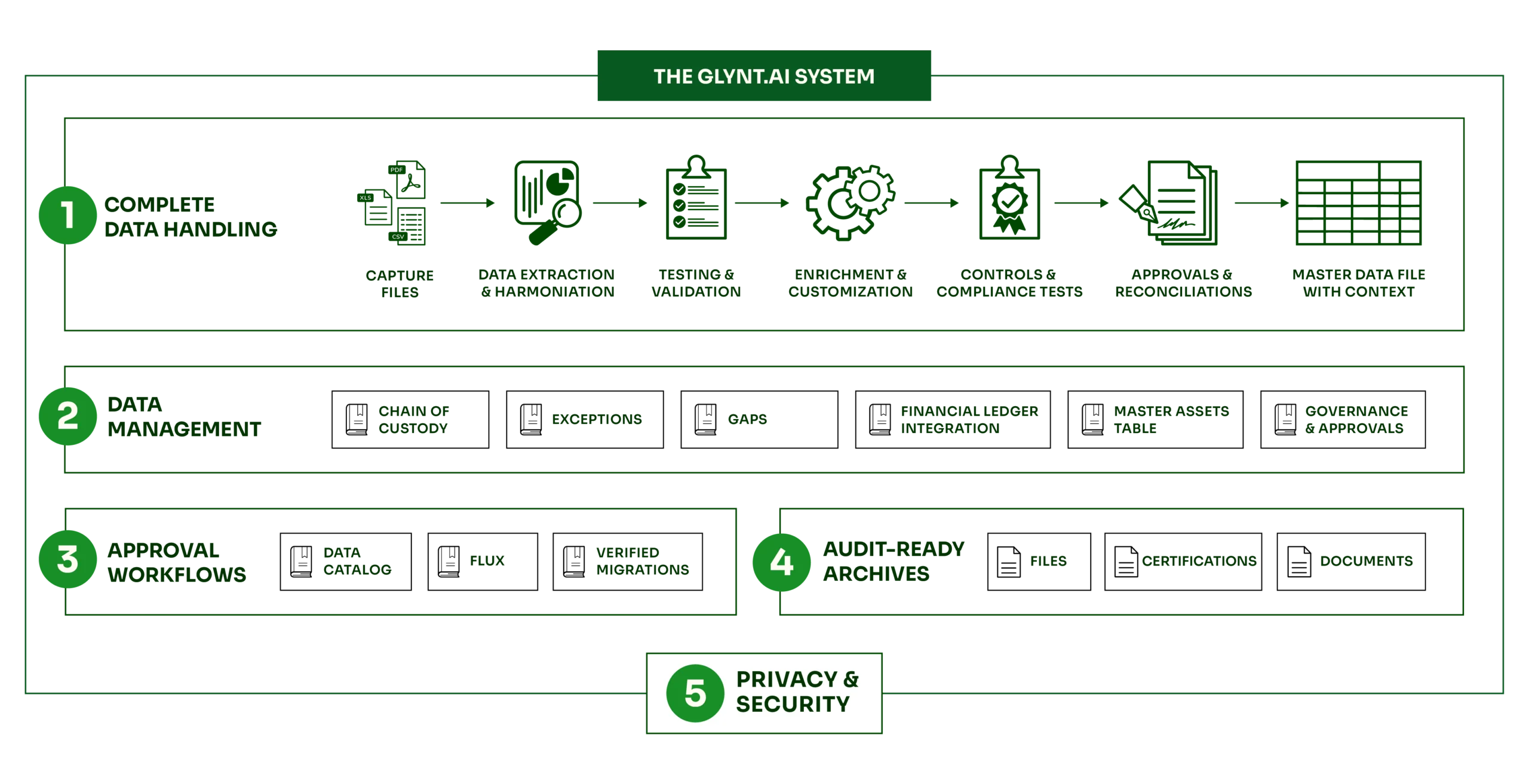
Auditors test the process and controls behind sustainability data, not just whether the numbers are accurate. GLYNT.AI’s automated system supports the five key components: complete data handling, data management, approval workflows, audit-ready archives, and privacy & security.
AUDIT EFFICIENCY
Three simple tasks keep audit costs down
Have your data, test results and documentation ready for the auditors. GLYNT.AI’s automation builds the audit-ready archive for you.
An accessible set of evidence
Keep all your data in one place, ready for sampling from the full population.
Tests and processes
Document your test procedures at both the data-point and system levels.
Change log
Keep records of your approvals and changes throughout the reporting year.
RELATED QUESTIONS
Common questions about audit-ready sustainability data
Browse frequently asked questions about sustainability audits and how automation can help to prepare audit-ready data.
What's the difference between limited assurance and reasonable assurance?
Reasonable assurance is similar to a financial audit, with detailed testing of data and controls. Limited assurance uses similar procedures, but far less extensively. While both raise confidence in the data, only reasonable assurance lets readers rely on sustainability data the way they rely on financial data.
Do we need to get all of our data audited?
No, but this is fast-changing. Upcoming standards, such as PACT, require 95–98% of all reported data to be included in the audit. This puts more pressure on sustainability teams, because the same standards discourage the use of estimated data.
What will the auditor be looking for?
Auditors look for two things: whether the numbers are right, and whether the process that produced them is sound. That means testing individual data points (data-level tests) as well as the methods, calculations, and controls behind them (system-level tests).
Will automated sustainability data lower our audit expense?
Yes. Your data systems will be documented, and your population of data will be verified and ready. Instead of chasing data contributors for records and files, automated systems like GLYNT.AI use monthly approval workflows to flag missing files and data, so you can address them early on. All this adds up to less work and fewer hours in the audit.
Is there an audit checklist for sustainability?
Yes. GLYNT.AI’s ESG and Sustainability Audit Checklist: Preparing Audit-Ready Data in 2026 covers the data, tests and documentation auditors ask for.
Do we need to get our data audited now, or can we wait a few years?
It depends on your jurisdiction, but waiting is riskier than it looks. The EU, California and ISSB are moving to reasonable assurance in the coming years, and Australia requires it by 2030. Typically it takes two or three audit cycles for sustainability teams to feel comfortable with their processes, so most companies are starting now.
How do sustainability audits differ from finance audits?
Sustainability audits differ from finance audits in two key ways. First, sustainability audits cover far more data source types (utility bills, invoices, EHS reports, waste reports, supplier surveys, engineering estimates and so on) than the accounting. Second, sustainability reporting standards are rapidly expanding and changing, so sustainability audit standards follow. While finance has decades of experience, sustainability audits are just getting started.
We use spreadsheets and manual data entry. How should we prepare for a sustainability audit?
Expect a harder, longer sustainability audit. Auditors will spend more time and ask more questions to understand where each number came from. Automating your sustainability data before the audit starts gives auditors one verified dataset, documented tests and a full change log, which cuts audit time and cost.
Learn more about Audits & Assurance