Product Overview

A quick look at the GLYNT.AI solution

Audit-Ready Sustainability Data

Prepared for ISSA 5000 and other audit standards

Sustainability Data Layer

Works with the software and AI you already use

Approval Workflows for Sustainability Data

Four-Eyes review for audit compliance

Finance-Grade Sustainability Data

The same rigor as financial data

Integrate with Financial Data

Reconcile against your financial ledger

AI-Ready Sustainability Data

See what’s missing or flagged before deadlines

Powered by Green AI

Built for low energy use and emissions

Best Practices for Sustainability Data Management

Manage data instead of wrangling it

Enterprise Security

Privacy, security, and controls

Sustainability Data Accuracy

We test your data so you don’t have to

Comprehensive File Capture

Extract data from scans, portals, and messy formats

Customized Reporting

See what’s missing or flagged before deadlines

Audits & Assurance

Traceable data, approval workflows with SOC compliance

Business Value Add

Customize output files for CSRD, IFSR, CBAM, UKSRS

Energy Data Management

Granular data for transparency and cost reductions

Waste Data Management

Pull files from everywhere, send data to anywhere

Scope 3 & PCFs

Stop chasing suppliers, move to finance-grade quality

Blog

What’s new with GLYNT

Customer Stories

Industry applications for GLYNT solutions

Guides

GLYNT’s expertise and thought leadership
GLOSSARY

What is GLYNT.AI’s Sustainability Data Layer?

GLYNT.AI’s sustainability data layer collects raw input files, prepares sustainability data with the same rigor as financial data, and delivers audit-ready data for reporting, business use, and AI.

INTEGRATION

How does GLYNT.AI’s sustainability data layer fit into your systems?

GLYNT.AI’s sustainability data layer sits between your raw data and your applications, handling all sustainability data preparation and data management for you. It collects raw input files from the Inputs Layer and delivers audit-ready, customized reports and data sets to the Application Layer, with no extra work on your end.
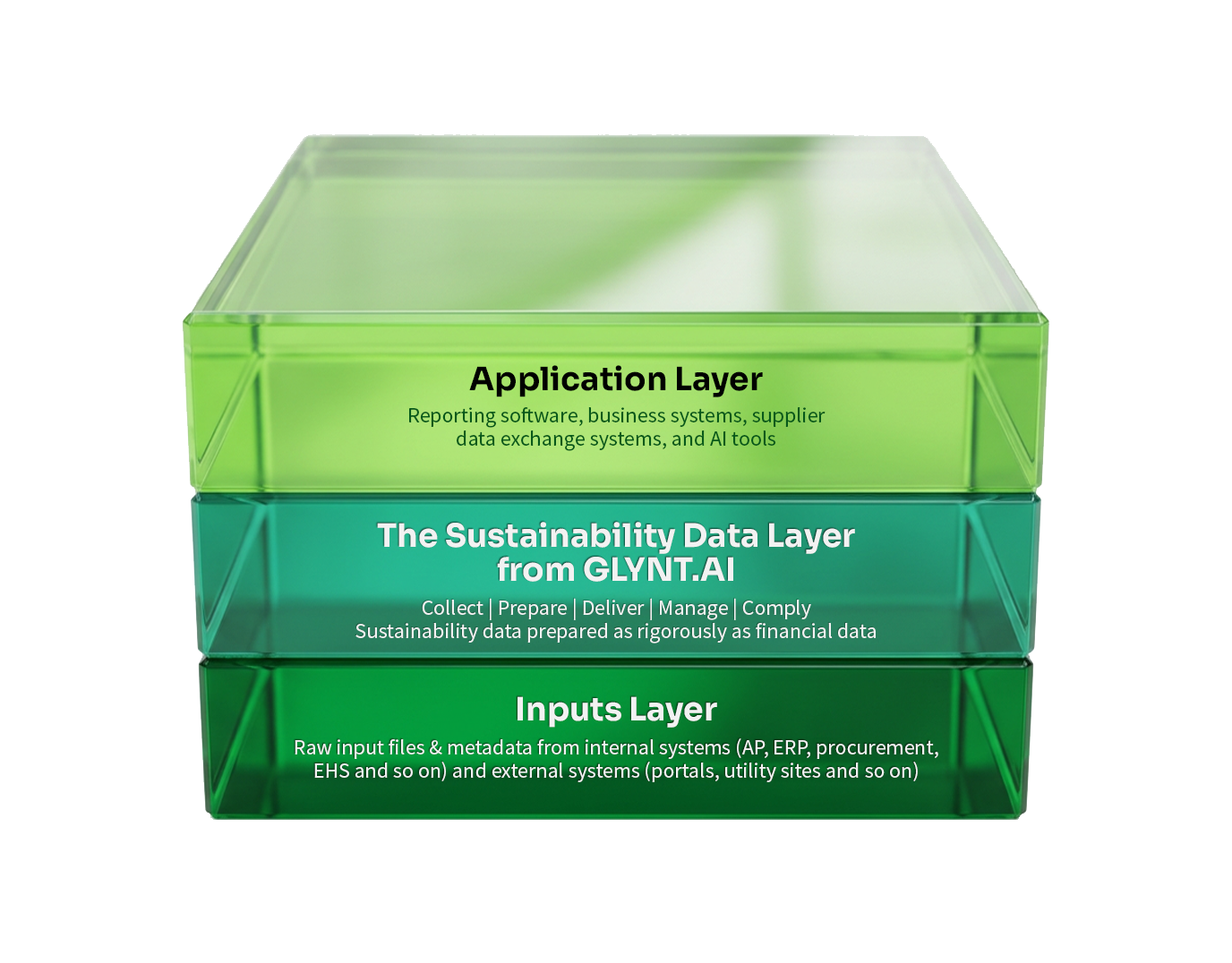
A stack of 3 glass layers titled Application Layer, The Sustainability Data Layer from GLYNT.AI, and on the bottom Inputs Layer
WHAT IT IS

5 key takeaways on the sustainability data layer

Here are five things to know about GLYNT.AI’s sustainability data layer.

Single system

It’s the one data system for all your sustainability data. A single system is more efficient to run and faster to audit than several separate ones.

Source of truth

It serves as your source of truth for sustainability data. The rigorous preparation built into the data layer gives every stakeholder the data confidence they need.

Fits your stack

It fits into your existing software and systems. Use the reporting software, business tools, and AI tools you already have.

Built to expand

It expands with your reporting and data-sharing needs. Add data sources, custom fields, or output formats as they come up.

Saves time and money

Accurate, audit-ready sustainability data requires a complete system, which is slow, uncertain and expensive to build in-house.

FAQS

Common questions about the sustainability data layer

Answers to the questions we hear most about GLYNT.AI’s sustainability data layer.

What does the sustainability data layer do?
It organizes the full process that turns raw sustainability data into structured, audit-ready datasets — collecting source files, then extracting, testing, enriching, and harmonizing the data before it reaches reporting and governance.

Why is it called a "data layer"?
In software, “data layer” refers to the technology that sits between incoming raw files and the finished, structured data that comes out the other side. GLYNT’s data layer is where the actual preparation work happens: data collection, extraction, testing, enrichment, before sustainability data reaches reporting tools, internal systems, or AI models.

What is the advantage of a unified sustainability data layer?
A unified data layer runs on prepare once, audit once, report everywhere. The same clean dataset can feed every downstream report without being rebuilt each time.

Is special training needed to use the sustainability data layer?
No. Day-to-day, the system runs on its own, no special training is required to use it. During setup, we’ll ask your team the key questions: What do you use your sustainability data for? Which fields you need? Where does your raw input files comes from? GLYNT runs a kickoff workshop and a structured onboarding process to answer these questions. If you don’t know the answers upfront, we’ll add discovery exercises that help find them.

What do we need to deploy GLYNT.AI’s sustainability data layer?
This depends on your current setup. Typically GLYNT and the customer collaborate during onboarding to tailor the GLYNT.AI system to your needs. For example, at one customer with a one-person sustainability team, GLYNT.AI handled all the integration and data mapping. For another customer with more complex IT systems, GLYNT worked with the customer’s IT team to specify the integrations and data flows.

How is the sustainability data layer different from finance-grade sustainability data?
These two different terms describe the GLYNT.AI data system from two angles. “Sustainability data layer” describes where it sits: the term comes from enterprise tech-stack architecture, the same way you’d describe a data layer or application layer in any system. “Finance-grade sustainability data” describes what it produces: sustainability data prepared with the same rigor as financial data, so you can trust it the way you trust your financial numbers.

What could you do with a standard sustainability data layer?