The Tech Stack for Sustainability Data
What is a tech stack for sustainability data?
The sustainability data tech stack is the fully integrated set of tools and systems that turns raw input files into audit-ready sustainability data — complete with testing and reporting built in. It’s how GLYNT.AI builds ESG and sustainability data governance into every step, for energy, water, waste and emissions data.
It’s more than a collection of tools: it’s a complete, compliant, enterprise-grade data management and governance system.
GLYNT.AI uses “sustainability data tech stack” and “standard sustainability data layer” interchangeably. “Data layer” emphasizes where this technology and workflow sit within your broader enterprise systems.
The sustainability data tech stack from GLYNT.AI
The sustainability data tech stack is a complete, integrated solution built to meet demanding audit and compliance requirements.
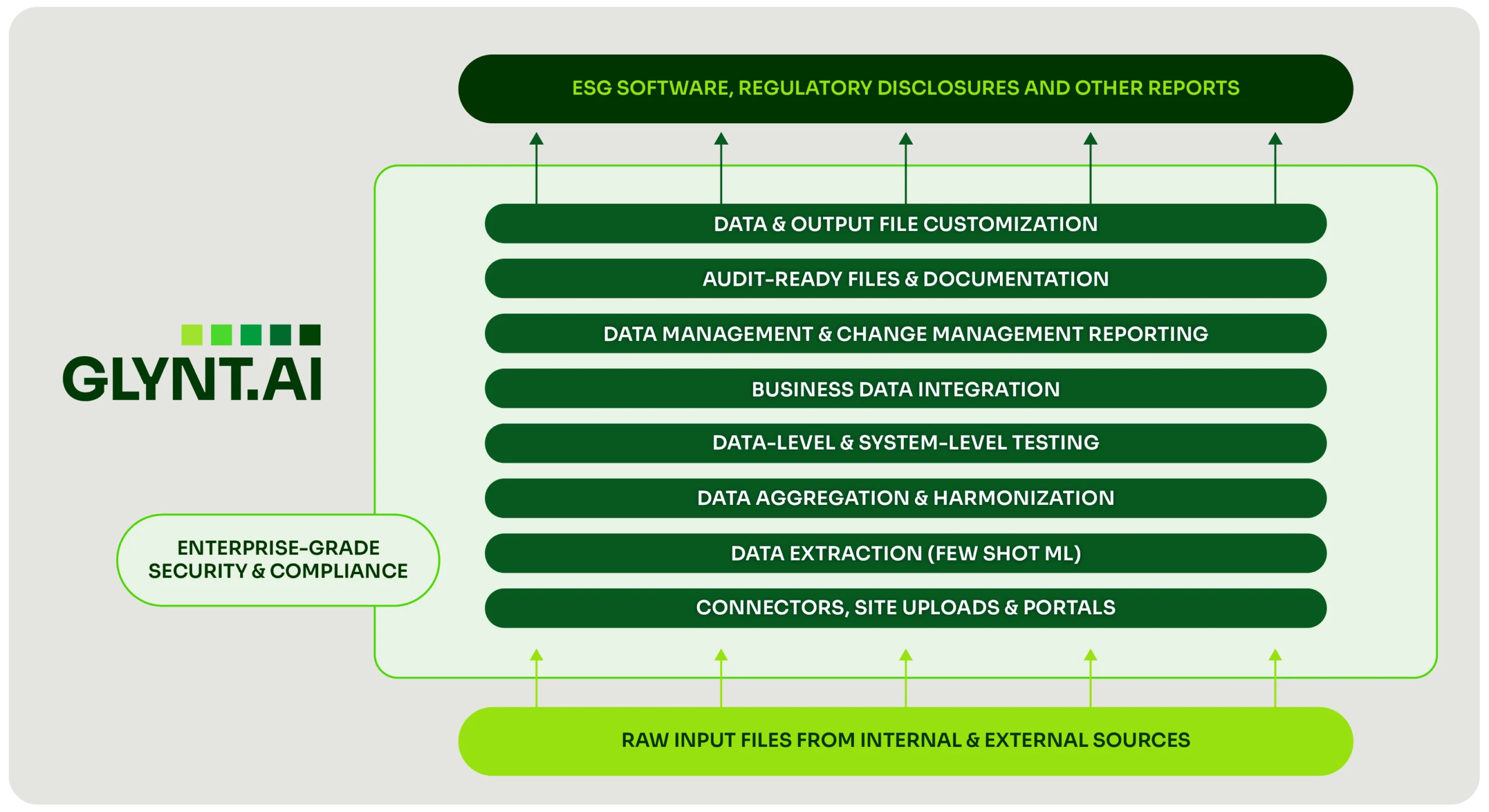
The sustainability data tech stack is a complete solution for automated data preparation.
GLYNT.AI integrates every tool needed for sustainability data preparation, applies the same system-level tests used in financial reporting, and undergoes an annual SOC audit — so you don’t have to build any of it yourself.
Save time
GLYNT.AI’s integrated tech stack automatically prepares your sustainability data.
Reduce risk
GLYNT.AI’s tech stack delivers audit-ready data from a compliant system.
Data you can trust
GLYNT.AI runs finance-grade, data-level and system-level tests; every number is verified.
Cost effective
GLYNT.AI delivers your first data in days and pays for itself in 4 months.
Scales globally
GLYNT.AI handles multiple languages and character sets, and large global footprints.
Tour the features of the sustainability data tech stack
We built the tech stack from customer experience, delivering a purpose-built data solution for sustainability teams.
Connectors, site logins & portals
GLYNT.AI connects to your data however it lives — through APIs and SFTP from enterprise systems, direct connections to utility sites, and upload portals for site-level submissions.
Data aggregation & harmonization
Raw input files vary widely in content and layout. GLYNT.AI uses a standardized data schema to aggregate and harmonize extracted data across your entire global footprint.
Business data integration
GLYNT.AI adds customer business data and metadata — such as site codes, SAP codes, or master vendor IDs — making sustainability data more useful for business decisions, strategic planning, and AI-driven analysis.
Data extraction
GLYNT.AI uses a proprietary “Few Shot” machine learning system for data extraction, adding dedicated models for each customer. This delivers 99.5% accuracy while fully segmenting every customer’s AI models and data.
Data-level & system-level testing
GLYNT.AI runs 65+ data-level accuracy tests, plus system-level tests for completeness, uniqueness, and reconciliation against key ledgers.
Data management & change management reporting
Sites, vendors, data sources, and formats constantly change in sustainability, and each change needs clear reporting. GLYNT.AI’s reports give sustainability, IT, and finance teams the visibility they need to manage and verify data flows.
Data & output file customization
GLYNT.AI customizes data fields and output files for seamless data flows into existing software and tools. Built-in customization is cost effective, as all data and output files go through GLYNT.AI’s rigorous testing and validation process; no customer developers required.
Enterprise-grade security & compliance
GLYNT.AI is audited annually and is SOC 1 and SOC 2 Type II compliant. SOC 1 is the standard public companies use for SOX.
Audit-ready files & documentation
GLYNT.AI provides a complete set of audit-ready assets that help customers streamline audits and reduce audit expense. These include data files, documentation, reporting and SOC reports.
Compare
How does GLYNT.AI’s sustainability data tech stack differ from ESG and carbon accounting software?
GLYNT.AI’s tech stack feeds the ESG and carbon accounting software you already use with finance-grade, audit-ready sustainability data.
A finance-grade data preparation
GLYNT.AI’s tech stack goes beyond a simple data pipeline, delivering sustainability data prepared with the same rigor as financial data.
Purpose-built AI
GLYNT.AI’s “Few-Shot” ML handles the wide variation and constant change in sustainability’s raw input files — speeding up data delivery and reducing manual, error-prone exceptions.
No developers required
As a complete data preparation system, GLYNT.AI integrates and tests every component for you.
Questions about the sustainability data tech stack
What is GLYNT.AI's sustainability data tech stack?
What is ESG and sustainability data governance?
How is GLYNT.AI's tech stack different from ESG or carbon accounting software?
How does GLYNT.AI extract data from raw input files?
How is GLYNT.AI's Few-Shot ML different from large language models (LLMs)?
How much energy does GLYNT.AI's AI use compared to other AI tools?
How does GLYNT.AI test and validate sustainability data?
Can GLYNT.AI customize data fields and output formats?
How does GLYNT.AI handle changes to sites, vendors, or data formats?
Is GLYNT.AI SOC 1 and SOC 2 compliant?
Is GLYNT.AI more cost-effective than building an in-house data system?
More Like This

The GLYNT.AI Guide to Utility Data
Read the Guide

AI with Lower Emissions
Read the Guide

Audit-Ready Sustainability Data Standards in 2026
ISSA 5000 applies to reporting periods from December 15, 2026. See how it fits with ISO 14064 and the GHG Protocol, and how to automate audit-ready data.
Read the Guide

The Sustainability Data Buyer’s Guide
Read the Guide