How double-verification ensures complete, audit-ready data every time.
One of the toughest challenges in sustainability is ensuring complete data. Sustainability teams rely on files transferred from other business systems, and prepared for a different use case. It can be hard to track the files, and also hard to track the sustainability data they contain. The challenge feels noisy and a bit chaotic to sustainability teams.
But, data completeness is a key principle of data quality in the GHG Protocols and all reporting standards. Data completeness lays the foundation for reliable, consistent sustainability reporting.
Fortunately, sustainability can borrow from best practices in financial accounting. High-volume accounting data flows face the same challenge: Never leave a file behind.
So how do they do it? With double-verification of incoming files:
- Technology verification. These tests and verifications are done with code or AI. They watch over the systems and file flows. Is the API working? Is the monitoring system watching what is delivered and verifying that the flows are correct?
- Logical, contextual verification. These tests rely on matching the files coming in to an external source of truth, e.g., a list of what should be received. Do the files match? Is there any business reason that says they should not? Use facilities lists, utility account lists, transaction lists from AP and ERP systems, log files from other systems and so on.
Note that financial accounting also has double-entry bookkeeping. This works at the transaction level, not the file level. The two double verification tests listed above work at the file level.
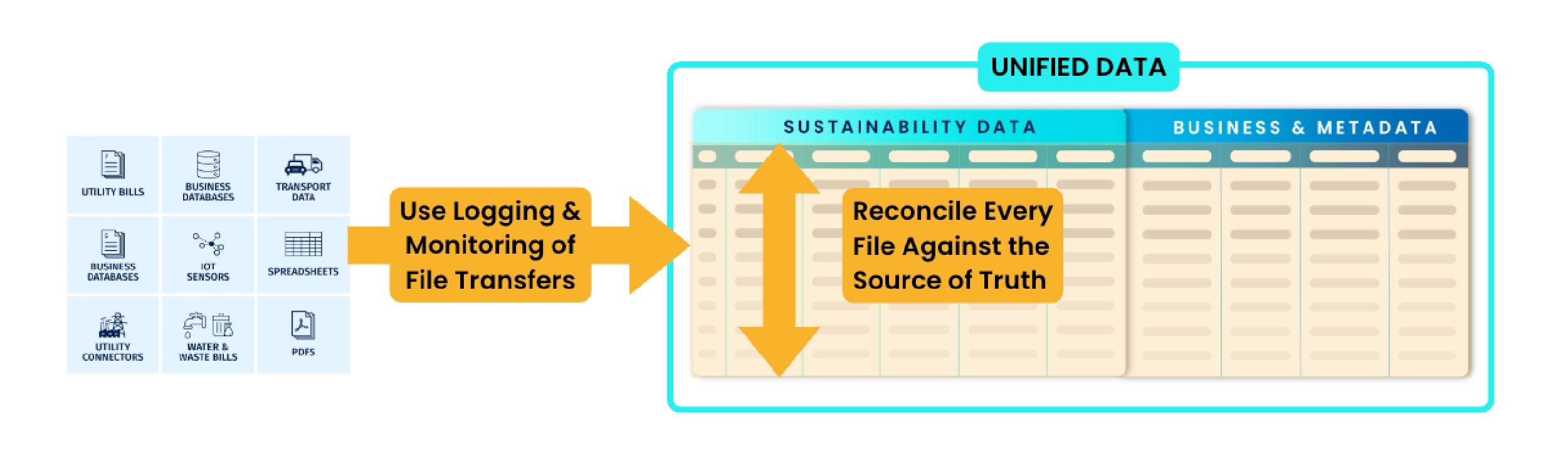
GLYNT.AI implements double verification for each customer during the onboarding phase. It is the only way to ensure complete files. Without double verification, some files may be missing and others may be double-counted. Both of these errors lead to year-to-year changes in reported data that are too noisy to make much sense.
Get sustainability data as rigorously prepared as financial data. Double-verification is a must-have. Talk to GLYNT.AI